







The Complete Guide to Prop Trading in 2026
Introduction
Prop trading, short for proprietary trading, has made a big impact in the way many traders interact with the markets. Prop trading provides an opportunity for individuals to simulate trading using a firm’s capital; earn actual profit payout from successful trades; and protect their own money from loss.
While there are similarities among many firms, the differences in how each firm operates are critical within a rapidly evolving prop firm market.
Prop trading is not a “get rich quick” scheme. To be successful in prop trading requires time, discipline and a level-headed trader. A quality firm, like Funded Trading Plus, will provide a trader with a consistent and fair trading environment that supports the trader’s ability to develop and demonstrate their skills through ongoing education, clearly defined rules and a sense of trust.
You’re trading on live prices, but instead of risking your own capital, you’re using a simulated capital provided by a prop firm. When you make money, you’ll receive a share of those profits. If you lose money, you won’t be losing your own money. This is essentially what prop trading is all about.
For many new traders, the barrier to entry is either lack of capital or fear of taking a significant financial risk. Prop firms provide a solution for these barriers by providing a simulated trading environment for learning, practicing and growing as a trader. Today, the regulatory and professional requirements of the markets are much greater than they were even a few years ago, which makes selecting a reliable firm a necessity.
Funded Trading Plus is one of the most transparent online prop trading firms and has built its reputation by keeping its rules clear, its payouts reliable, and its support genuinely helpful. Traders know what to expect from the moment they join, and every stage of the process is explained in plain language. This commitment to fairness sits at the heart of the firm’s 5 star customer promise.
In this Prop Trading 101 guide, we’ll break down:
✔ What is prop trading?
✔ How does it actually work?
✔ How to qualify for simulated funded accounts.
✔ The differences between retail and prop trading.
✔ How to compare different firms.
✔ The importance of trust when choosing a prop firm
✔ Why transparency and fairness matter most.
Table of contents
Let’s dive in! 👇
What is Prop Trading?
Prop trading, or proprietary trading, allows individuals to trade financial markets using a firm’s simulated capital instead of their personal funds. Traders must pass an evaluation to prove their risk management skills. Successful participants gain access to a simulated funded account and earn performance-based rewards calculated from simulated profits.
Prop trading has fundamentally changed how traders interact with the markets. It provides an opportunity to test your edge in a simulated environment without risking your personal savings. However, prop trading is not a “get rich quick” scheme. Success requires time, discipline, and a level-headed approach.
A quality firm like Funded Trading Plus provides a consistent, fair trading environment that supports your ability to develop skills through clearly defined rules and absolute transparency. Here is everything you need to know about the prop trading model in 2026.
How Does Prop Trading Actually Work?
A firm that provides prop trading services acts primarily as the provider of the environment to allow a trader to test their skills. In general, a trader will pay a one-time fee to take a challenge . This evaluation is designed to filter out reckless behaviour and see whether the trader can trade consistently within the firm’s risk rules.
Once the trader completes the challenge successfully, they advance to a simulated funded account. The capital is virtual, the risk sits with the firm, and the trader has the opportunity to earn performance-based rewards calculated from the simulated profits they generate.
What Is the Difference Between Prop Trading and Retail Trading?
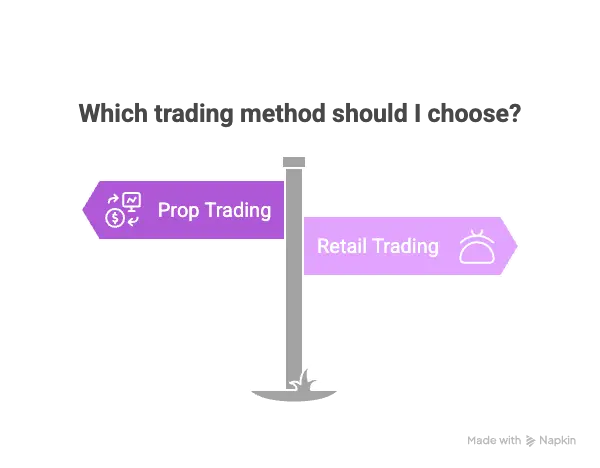
Prop Traders take a completely different approach. As a prop trader, you will be trading simulated firm capital. The risk will be assumed by the firm, and your role will be to demonstrate consistent performance and control. Due to the fact that there is less of a barrier to entry in order to get started, and you will be able to learn from your experiences in a real-time environment, many traders believe it to be an easier way into the world of trading at a professional level.
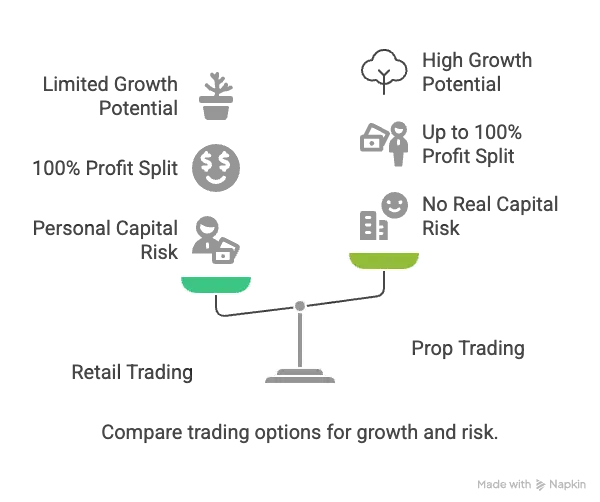
| Feature | Prop Trading | Retail Trading |
| Risk | No real capital risk | Trader risks personal money |
| Profit Split | Up to 100% to trader | 100% to trader |
| Growth Potential | Can scale up to $2.5M | Limited by personal capital |
| Capital | Firm provides simulated capital | Trader uses personal funds |
| Trading Rules | Must follow firm’s risk limits | Broker Limitations |
Prop trading is ideal for skilled traders who lack capital but want to scale their trading career in a simulated environment!
How to Compare Prop Firms in 2026
With so many options available when choosing which prop firm you want to trade with, all firms appear to offer similar incentives for traders. The only way to truly differentiate between the firms and select the most suitable for you is to focus on what matters the most – How do they treat you? Are they transparent with you about payout? Are they fair in how they treat you?
What should you be looking for?
Profit Split and Payout Speed: The profit split percentage does not matter if you cannot get paid. Find a firm that pays out fast and is clear about processing withdrawals.
Rules and Flexibility: Read all the rules. If the rules are simple and straightforward, the firm is probably doing things right. If there is a lot of complicated fine print, it may indicate the firm has hidden agendas and/or may have unfair policies.
Scaling Plans: Does the firm have a plan in place for scaling up your simulated account as your profits continue to grow and demonstrate consistent performance?
Is the firm’s drawdown type a fixed amount or trailing your equity? This will affect how you use leverage and manage your trading risk.
Education and Support: Some firms provide traders with additional tools such as education, support, access to data, or even mentoring. These resources can greatly benefit your success as a trader.
Ultimately, find the firm that demonstrates the most trust and fairness, and not just the firm that yells the loudest.
How to Get Funded by a Prop Firm
The route to a funded account looks simple but demands discipline.
1️⃣ Join a Challenge
Register for an evaluation, usually on a demo platform that mirrors real prices.
2️⃣ Trade Within the Rules
Follow the firm’s limits on drawdown, risk, and position size. Stay consistent.
3️⃣ Pass the Evaluation
Reach the target profit without breaking the rules and you’ll qualify for a funded stage.
4️⃣ Trade for Payouts
Once funded, trade under the same conditions. Profits you earn are real payouts, even though the trading capital remains simulated.
Remember, the funded account is still a simulation. The money isn’t real market capital, but your payouts are, based on your performance.
Common Reasons Traders Fail
- Taking oversized positions
- Breaking drawdown limits
- Letting emotions take over
- Ignoring consistency rules
- Trying to rush the process
Treat it like a professional test, not a gamble, and your odds of passing go way up.
Pros and Cons of Prop Trading
Every trading approach has two sides.
Advantages
✔ You don’t risk personal capital.
✔ You can trade larger simulated accounts than you’d ever fund yourself.
✔ Profit shares can reach 80–100%.
✔ You can trade different markets — forex, indices, crypto, or commodities — within the firm’s rules.
Disadvantages
❌ Strict rules apply.
❌ Some firms keep a share of profits.
❌ Evaluation fees can add up if you need multiple tries.
For disciplined traders with a clear plan, it’s a fair and practical path to grow experience without the stress of personal loss.
Who It’s Best For
✅ Traders who already have a working strategy but limited capital
✅ Careful risk managers who value rules and structure
✅ Ambitious learners wanting a low-risk route toward professional standards
Best Strategies for Prop Trading Success
The strategies that work best in a prop firm are those that offer defined risk and repeatable execution.
- Trend Following Strategy: Utilise moving averages (like the 50 & 200 EMA) to identify broad trends. Wait for pullbacks to enter in the direction of the momentum, setting a strict stop loss below key structural support.
- Breakout Trading Strategy: Identify consolidation zones or opening ranges. Place entry orders as price definitively breaks through resistance or support, using tight stop losses to minimize risk on false breakouts.
- Mean Reversion Trading: Look for overbought or oversold conditions using tools like VWAP, RSI, or Bollinger Bands to trade stretched price action back to its average.
(For a deeper dive into the exact rules, entries, and exits of these high-probability setups, explore our complete breakdown of the top 10 prop trading strategies picked by real traders).
How to Choose the Right Prop Trading Firm
What to Look for in a Prop Firm
The best firm isn’t always the one with the highest payout offer. It’s the one that earns your trust.
When comparing, focus on:
✔ Profit Split: 80–100% is common, but always read the small print.
✔ Payout Speed: Look for proof that traders are actually being paid.
✔ Risk Rules: Understand static versus trailing drawdowns before you start.
✔ Scalability: Can you grow your account size as you perform?
✔ Transparency: The firm should be clear about fees, timing, and rules from the outset.
A fair firm gives you confidence to focus on trading, not worrying about what’s behind the scenes.
📌 Funded Trading Plus is one of the few firms offering 100% profit share, making it a top choice for traders!
Why Trust Matters in Prop Trading
The prop industry has grown fast, and with that growth come firms that promise a lot but deliver little. Delayed payouts, unclear rules, or sudden policy changes are the things that ruin trader confidence.
Research shows most traders rate payout reliability as the top reason for choosing one firm over another. It makes sense. Consistent results only matter if you actually get paid for them.
When researching, look for:
- Publicly verified payouts
- Transparent rules and pricing
- Genuine reviews on independent platforms
Be wary of firms that use vague blockchain or crypto data to “prove” payouts. Those records often don’t show who was paid or why. Real proof comes from verified trader testimonials and consistent behaviour over time.
📌 Always research a firm thoroughly before committing to a challenge. A firm with genuine trader reviews and a proven track record is far more reliable than one with paid rankings on review sites. Learn about Funded Trading Plus here.
📢 Conclusion & Next Steps
Prop trading offers individuals an opportunity to improve their trading skills while minimising the potential loss associated with using personal funds. Prop trading also provides individuals the ability to learn how to trade by providing a safe, controlled environment to practice patience, control and strategy.
The firm that you choose will provide a very different experience than another. Research thoroughly, check reviews from actual traders, and take the time to fully understand each and every rule prior to making your first payment for the challenge.
When done correctly, prop trading can serve as a valuable learning experience and may eventually lead to further career advancement in professional trading.
🔥 Ready to Explore Prop Trading?
If you’d like to try prop trading, start with a reputable firm that clearly states it uses simulated trading environments and that all payouts are based on performance within that setup. Prop evaluations aren’t investments, and there are no guaranteed outcomes. They’re structured tests designed to reward skill, not speculation.
Take your time, trade with discipline, and treat each evaluation as a step toward becoming a more capable, consistent trader.
Prop Trading 101 – Frequently Asked Questions
Prop trading, short for proprietary trading, is when a firm allows individuals to trade using its simulated capital to generate profits. Traders earn real payouts from performance, without using their own funds.
A prop trading firm provides access to simulated trading environments, where qualified traders can earn real payouts by hitting profit targets and managing risk within firm guidelines.
Yes, many prop trading firms are legitimate and operate legally in most countries. Reputable firms use simulated environments, clearly state their rules, and have transparent track records with real trader reviews.
Online prop firms operate in non-regulated, simulated environments, meaning they’re not subject to the same regulations as brokers. However, trustworthy firms follow strict internal standards around transparency, fairness, and trader compliance.
Absolutely. If you can consistently trade profitably within the firm’s risk parameters, you can earn real payouts, even though you’re trading with simulated capital.
They earn primarily through evaluation fees paid by traders attempting to qualify for funding. A smaller portion of their revenue may also come from technology services or educational products, not trader losses.
Firms assess traders via a simulated trading challenge. If a trader meets the required targets and follows the firm’s prop trading rules, they may receive a funded account for real profit-sharing.
Start by selecting a reputable firm, register for their evaluation challenge, and trade under their rules. If you pass, you could receive access to a simulated funded account.
Sign up for a firm’s evaluation program, meet their profit and risk criteria, and, if successful, you’ll be granted a funded account to begin trading for real payouts.
Earnings vary by trader performance. Consistent, rule-abiding traders can earn substantial payouts often scaling as their funding level increases.
Prop trading rules are the guidelines traders must follow to qualify and maintain funded status. These include profit targets, maximum drawdown limits, trading time restrictions, and consistency requirements, all within a simulated trading environment.
No. Hedge funds manage client money under financial regulations. Prop firms use their own or simulated capital, and allow individual traders to earn payouts without managing outside funds.
Yes, most reputable prop firms have technology to detect mirror or copy trading, which is often against their terms of service.
Most firms charge a modest fee for evaluations. However, many offer low-cost challenges and retake options to support traders of all levels.
Start by choosing a trusted firm like FT+, pass an evaluation that tests your risk management and profitability, and you could get access to a simulated funded trading account.
They evaluate traders using demo environments and fund those who meet profit and drawdown criteria. FT+ offers some of the industry’s fairest evaluations with low failure rates.
Sign up with a firm like FT+, select an evaluation program, pass the challenge, and get access to a simulated funded account.
Starting a firm requires operational capital, legal infrastructure, a trading platform, and a risk-management model. For most, joining an established firm is the simpler path.
Market makers profit by quoting bid/ask spreads. Prop traders speculate on market moves using firm-provided capital under strict trading conditions.
Most firms charge a modest fee for evaluations. However, many offer low-cost challenges and retake options to support traders of all levels.
Top online prop firms include industry leaders like FTMO and Funded Trading Plus, known for transparent rules, fast payouts, and trader support.
Since prop firms use simulated capital and do not charge interest, many traders use them to pursue Sharia-compliant strategies.
Which FT+ Evaluation is Right for You?
Whether you are refining your established edge or testing a new approach, finding the right environment to execute your trades is critical. At Funded Trading Plus, we have built a simulated platform that gives you the autonomy to trade your way.
You can explore our streamlined one step challenge for complete flexibility, opt for our traditional two step evaluation if you prefer a phased approach, or discover our instant funding program with no profit targets to begin trading a simulated funded account immediately. Choose the program that aligns with your risk management plan and start your simulated trading journey today.